The Quiet Achiever: A £500 Vinyl System for UK Flats With Paper-Thin Walls
Most UK flat-dwellers do not have a dedicated listening room. They have a spare bedroom, a bay-window corner, a desk beside a radiator or a front room that doubles as a bike store. The walls are thin, the floors are shared and the neighbour on the other side has a shift pattern. The good news is that a £500 vinyl system can sound genuinely involving in that sort of space. It just requires a different set of priorities from the internet’s default advice of more power, bigger speakers and a subwoofer.
Why thin walls change the brief
In a detached house with a big lounge, you can chase scale. In a rented flat or a Victorian terrace with a party wall, you are chasing compromise. Bass is the usual flashpoint. Low frequencies travel through structure, so a ported standmount pushed against a chimney breast will annoy people long before the mids and highs do. The aim is not to make the system quiet. It is to make it expressive at sensible levels.
That means three things. First, choose speakers that work close to a wall without boomy reinforcement. Second, decouple them from shelves and floors so energy does not turn the building into a soundboard. Third, accept that a nearfield listening position is your friend. Sit closer, turn down, and let the speakers do less work. A pair of small standmounts at 1.5 metres can sound more detailed than floorstanders at four metres in a room that is fighting back.
The £500 blueprint
This is a flexible shopping list, not a prescription. Prices are typical for 2026 and assume a mix of new and used kit. If you already own a turntable or amp, spend the spare cash on speakers and isolation.
| Part | Sensible choice | Typical price |
|---|---|---|
| Turntable | Audio-Technica AT-LP60X or used Pro-Ject Essential | £130–£180 |
| Amp | Used Cambridge Audio Topaz AM10 or NAD C316BEE | £90–£140 |
| Speakers | Used Q Acoustics 3010i or Wharfedale Diamond 9.1 | £120–£180 |
| Isolation | Rubber/cork pads and a stable shelf | £25–£50 |
| Cables | Basic speaker cable and a decent RCA lead | £20–£35 |
That lands around £385–£585 depending on luck and condition. The trick is not to spend £500 on one shiny component and then balance it on a wobbly IKEA shelf. A £120 used amp with clean switches is better than a £300 new amp with a noisy volume pot.
Turntable: enough, not too much
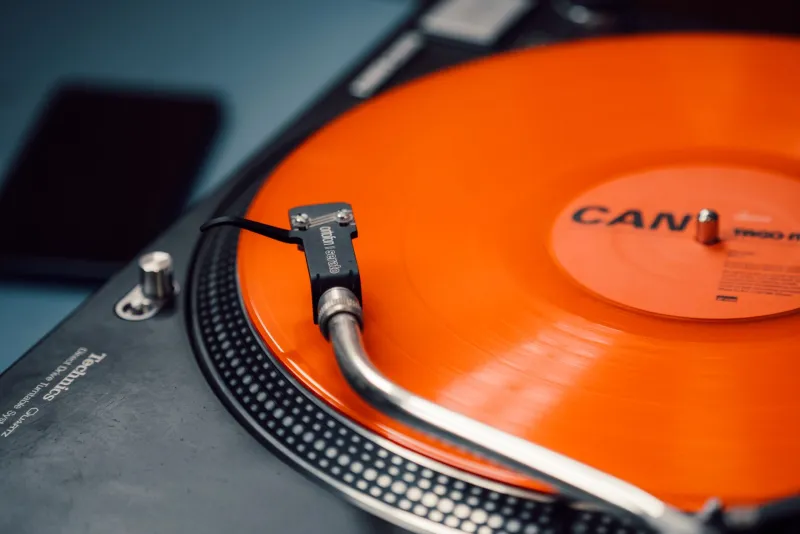
For a first vinyl system in a flat, a simple belt-drive deck with a built-in phono stage is hard to beat. The AT-LP60X is not an audiophile trophy, but it tracks reliably, costs little and leaves budget for speakers. If you go second-hand, look at Pro-Ject, Rega or older Dual decks. Check the stylus, the belt and the cueing mechanism. A worn stylus is a false economy and can damage records.
Do not overlook the phono stage. If your amp lacks one, a compact £40–£70 external box is fine at this level. You do not need to spend more on a phono stage than on the turntable itself.
Amp: small, sensible, second-hand
A compact integrated amp from the last 15 years is the sweet spot. Cambridge Audio, NAD, Marantz, Yamaha and Rotel all made sensible small amps that sell used for £80–£150. You want clean switching, a working volume control and enough inputs for a turntable and a streamer later. Avoid anything with a noisy fan or a cracked display.
If you are renting and short on space, a mini amp with Bluetooth can work, but check the phono input. Many cheap mini amps omit it. You can add a separate phono stage, but that is another box and another cable.
Speakers: standmounts, not subwoofers
This is where most of the sound lives. A used pair of Q Acoustics 3010i, Mission LX-2 or Wharfedale Diamond 9.1 will give you a balanced, room-friendly sound. Sealed or front-ported designs are easier to place near a wall than rear-ported boxes. Small speakers will not deliver room-shaking bass, and that is the point. In a flat, a little bass that stops and starts is better than a lot of bass that leaks through the floor.
Put them on stands if you can. Used metal stands cost £30–£60 and do more for clarity than a fancy cable. If stands are not practical, use a sturdy desk or shelf and bring the speakers forward so they are not buried against the wall. Angle them slightly towards your ears.
Isolation and the neighbour problem
Isolation is the least glamorous part of the build and the most useful. Put the turntable on a solid shelf, not on a suspended floorboard next to the speaker. Use rubber and cork pads under the speakers. A granite chopping board from a kitchen shop can work as a cheap platform. Keep the turntable and speakers off the same surface if possible.
Volume discipline matters more than any gadget. A small room does not need 95 dB peaks. Aim for 70–75 dB most of the time, with the odd louder session when the neighbours are out. If you can hear the bass thumping in the hallway, so can they. Headphones are not a defeat; they are a sensible flat-dweller’s second system.
The real upgrade is the room
Before you buy a better cartridge or a mains cable, deal with the room. A rug, a curtain, a bookshelf and a sofa absorb reflections. Move the speakers a few centimetres. Sit closer. These changes cost nothing and often beat a component upgrade. In 2026, the second-hand market is full of good small hi-fi, so patience is a genuine budget strategy.
The £500 thin-wall system is not about compromise for its own sake. It is about recognising that a flat is a listening room with neighbours attached. Choose efficient, small, well-isolated gear, keep the bass honest and spend the rest on records. That is a hi-fi system that earns its place in a shared building.