Your Shelving Is Part of the Band: A Flat-Pack Field Guide to Better Hi-Fi

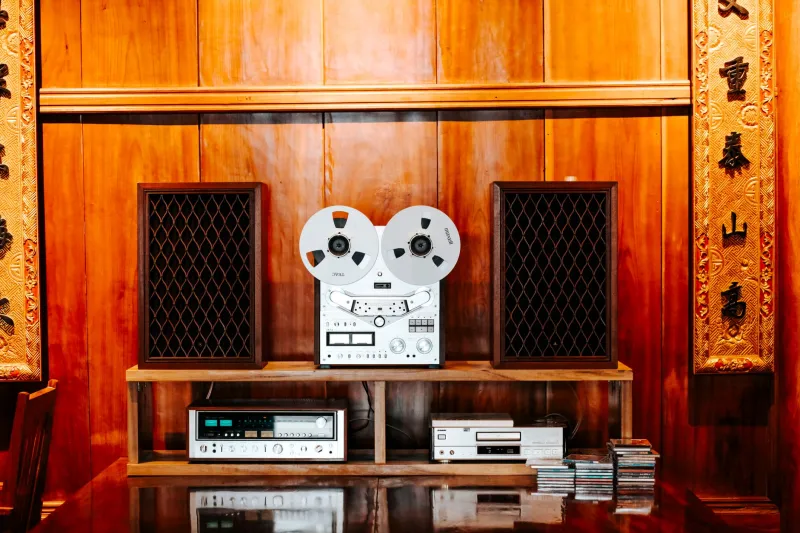
Photo: GACWLUBOR HAMUIG, CC BY-SA 4.0, via Wikimedia Commons
Most UK hi-fi systems do not live in dedicated listening rooms. They live in the front room, the spare bedroom, the rented flat with the boiler cupboard that hums in D minor. And in almost every one of those rooms, the system is sitting on furniture that was chosen for price, dimensions and whether it would fit through the door — not for acoustic neutrality.
That is fine. It is also unavoidable. The question is not whether your flat-pack shelving affects the sound. It does. The useful question is whether you can persuade it to help rather than hinder, without spending a fortune on racks and isolation platforms that cost more than the amplifier.
The boring physics bit, kept short
Every surface in your room stores and releases energy. A speaker cabinet vibrates, a shelf flexes, a floorboard moves, and a turntable picks up the lot. Cheap chipboard, honeycomb-core shelves and thin sideboards are not evil — they are just light and stiff enough to ring at frequencies that land right in the music. Bass is the obvious culprit: it makes furniture join in. But treble suffers too, because shelf edges, cubby holes and clutter create lots of tiny early reflections that smear detail and make cymbals sound like they are being played through a tea towel.
None of this is mystical. You can hear it easily. Put a speaker inside a Kallax cube, play something with a firm bass line, then move the speaker onto a proper stand a foot away. The difference is not subtle. It is the difference between a bass note and a bass noise.
Furniture can be your friend
Here is the counterintuitive bit: a full record shelf is one of the best acoustic objects in a normal home. Records are heavy, irregular and slightly absorbent. A Kallax packed with LPs is no longer a hollow drum; it is a big lump of mass that also scatters reflections. A sideboard loaded with books and cables can do the same job. Even a cheap shelving unit, properly filled and fixed to the wall, stops behaving like a musical instrument.
The trick is to stop treating furniture as a neutral platform. It is part of the system. A wobbly desk under a turntable is a feedback generator. A shelf with speakers in the cubes is a boom box with delusions of grandeur. A heavy sideboard with the turntable on top and the speakers on stands either side is a perfectly sensible start.
Where it usually goes wrong
The classic mistake is putting speakers inside shelving. It looks tidy. It keeps the room usable. It also blocks ports, loads the bass into a small cavity and puts the tweeter at the height of your knees. If you have done it, you are not alone — half the hi-fi photos on the internet feature a pair of speakers wedged into a Kallax like books.
The second mistake is putting the turntable on the same surface as the speakers. Even at modest volume, the stylus is trying to read a microscopic groove while the shelf underneath is being shaken. Suspended wooden floors in Victorian terraces and older council flats make this worse. So does a cheap flat-pack desk with more flex than a yoga instructor.
The third mistake is assuming record storage is automatically good. It is, if the shelves are stable and fixed to the wall. It is not if the unit is overloaded, leaning, or sitting on a floating floor with the turntable on top. Records are heavy. A full Kallax can weigh more than some people expect, and the wall fixings matter.
Five free or cheap fixes that actually work
1. Get the speakers out of the cubes
This is the biggest single improvement for most people. Move the speakers to the top of the unit, or better, onto stands either side. You do not need boutique stands. A pair of sturdy second-hand stands from a local advert, or even concrete blocks wrapped in felt, will do more for bass tightness than most cable upgrades. Keep the tweeters roughly at ear height when you are sitting down. If stands are impossible, at least pull the speakers forward so they are not firing out of a tunnel.
2. Break the vibration path
You do not need to spend £200 on isolation. Washing machine feet, cork pads, Blu-Tack, dense foam or cheap silicone isolation pads can all help. Put them under speakers if the surface is resonant, and under the turntable if the shelf is less than rock-solid. The aim is not to float the kit in mid-air; it is to stop energy travelling efficiently from cabinet to furniture to stylus. A £10 pack of pads is a reasonable experiment. If it makes no difference, you have lost a tenner and gained some knowledge.
3. Mass-load and brace the shelving
An empty Kallax is a drum. A full one is furniture. Fill empty cubes with records, books or even sealed boxes of winter coats. Tighten every fixing you can reach. If the unit still feels wobbly, add a back panel or a simple cross-brace. Fix it to the wall if it is not already — not just for sound, but because a loaded record shelf falling over is a genuinely bad day. Mass and rigidity are your friends here.
4. Rethink the turntable perch
If you have a suspended wooden floor, a wall-mounted shelf is often the cheapest serious upgrade you can make. It decouples the deck from footfall and speaker vibration. Rented accommodation makes this trickier, but a heavy sideboard on a solid floor can work well. Just keep the turntable off the same surface as the speakers. If that means moving the deck to a different unit, do it. It costs nothing but a bit of reorganisation.
5. Tame the edges and the clutter
Pull speakers slightly forward of the shelf front so sound is not immediately bouncing off a lip of chipboard. Avoid deep cubbies directly behind the speakers. Soft furnishings, curtains and a rug help more than you think, especially in a room with bare floorboards and a bay window. And keep the space around the turntable reasonably clear. A shelf packed with nick-nacks is not a diffuser; it is a obstacle course for sound.
The takeaway
Before you buy a new DAC, a mains cable or a set of fancy feet, spend an afternoon with the furniture you already own. Move the speakers out of the cubes. Put something heavy under the turntable. Fill the empty shelves. Fix the unit to the wall. Pull the speakers forward. These are not audiophile tweaks; they are basic room setup, and they cost little or nothing.
The Kallax effect is real, but it is not a curse. Flat-pack furniture is part of the system, just like the cartridge and the carpet. Work with it, and your hi-fi will sound tighter, cleaner and less like it is playing from inside a wardrobe.